
New · Psychosocial risk assessment tool
Psychosocial risk assessment that turns compliance into real support
Identify psychosocial hazards in the workplace, meet your legal duty and act on what you find. Run a validated, anonymous psychosocial risk assessment survey, see every risk compared against a reference, and turn priorities into control measures connected to Siffi’s therapy, coaching and leadership programmes.
- COPSOQ III questionnaire
- Anonymous · groups of 5+
- Follows ISO 45003 guidance
- Survey in 10 languages
Not ready for a full assessment? Start in 2 minutes.
Take the free readiness check to see where your organisation stands on mental health, then decide whether a psychosocial risk assessment is your next step.
Take the 2-minute assessmentMost risk assessments end in a PDF. Yours should end in change.
Most psychosocial risk assessment tools stop at the report, and wellbeing benefits aren’t linked to the risks you found. Siffi connects the two into one psychosocial risk management process, so every risk you document has an owner, an action and a way to support the people affected.
Compliance-only tools
Identify risks, file a report
You meet the paperwork duty, but employees see nothing change, and work-related stress stays where it was.
Wellbeing benefits alone
Support, with no link to risk data
Coaching and therapy help individuals, but they aren’t aimed at the risks behind the stress, and you can’t show their impact.
Siffi psychosocial risk assessment
From risk to measure, and back again
Every priority risk gets organisational controls first, targeted Siffi support second, and a re-measurement to prove it worked.
The psychosocial hazards we measure
The survey covers 14 risk areas: the core COPSOQ III dimensions, grouped the way ISO 45003 describes psychosocial risks, plus two indicators for digital work that most questionnaires miss.
How work is organised
- Workload & work pace
- Emotional demands
- Influence at work job control
- Role clarity
Social factors & leadership
- Quality of leadership
- Social support & community
- Recognition & reward
- Offensive behaviour bullying and harassment, threats, violence
Work-life & security
- Work-life balance
- Job security & fairness
- Meaning of work
- Development possibilities
Siffi digital supplement
Digital work
- Digital connectivity outside hours right to disconnect
- Algorithmic monitoring & decisions tracking, automated decisions
How to conduct a psychosocial risk assessment
The same four-stage process regulators describe (identify, assess, control, review), in one workflow for HR, managers, worker representatives and occupational health.
Identify hazards
Employees answer an anonymous psychosocial risk questionnaire: COPSOQ III plus Siffi’s digital-work indicators.
60%+ response target
Assess risks
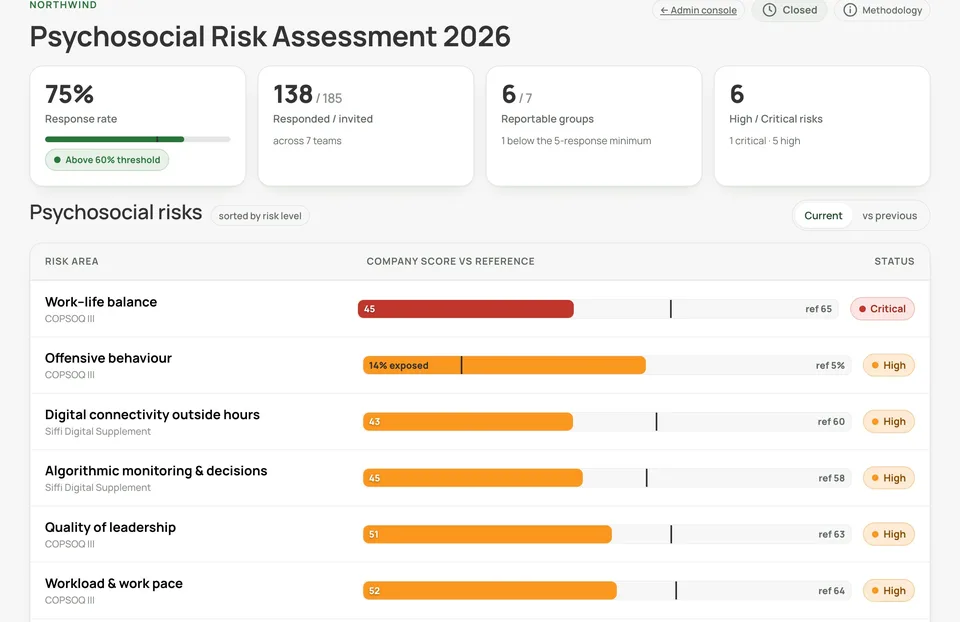
Scores are compared against a reference and ranked from Critical to Low, by company and by team.
Risk map
Control
Pick control measures for each priority risk: organisational first, individual support second. Assign owners and deadlines.
Action plan
Document & review
The worker representative and OSH specialist review and sign off. Export the full record as a PDF.
Compliance record
Monitor
Launch a short pulse on a single risk to check whether the action is working, then track it over time.
Trend history
Repeat yearly, or after major organisational change
Control measures for every psychosocial risk
Siffi suggests controls for each risk you prioritise, following the hierarchy of controls: fix the work first, then support the individual. Individual support links straight to services your employees can use the same day.
| Psychosocial risk found | Organisational controls (first) | Siffi support (second) |
|---|---|---|
| Work-life balance Critical |
| 1:1 coaching and therapyPersonal support for employees under strain |
| Quality of leadership High |
| Leadership coachingFor managers of the lowest-scoring teamsManager eTraining bitesShort online lessons for managers |
| Workload & work pace High |
| Time-management coachingPlanning and prioritisation |
| Emotional demands Moderate |
| Confidential counsellingTherapists in 40+ languages |
- Your organisation acts
- Siffi supports your people
Document your psychosocial risk assessment, ready for any inspection
- Method, participation and reference data recorded automatically, so you can show you’ve met the legal requirement
- Priority risks with chosen controls, owners and deadlines
- Review and acceptance by the worker representative and OSH specialist
- One-click PDF: compliance record and full analysis report
- Re-measurement history that shows whether actions worked
Individual answers are never shown. Results appear only for groups of five or more.
Compliance record
Psychosocial Risk Assessment & Action Plan
Northwind · 2026 · COPSOQ III + Siffi digital-work indicators
| Priority risk | Action | Owner | Due |
|---|---|---|---|
| Work-life balance | Working-time norms | COO | Q1 |
| Leadership | Manager programme | HR lead | Q2 |
| Workload | Workload check in 1:1s | Team leads | Q1 |
Worker representativeReviewed & accepted
OSH / occupational healthReviewed & accepted
A psychosocial risk assessment built on recognised standards
Designed for EU employers, with Estonian and other national requirements in mind.
- EU Framework Directive 89/391/EEC
- Employers must assess all risks to workers’ safety and health, including psychosocial ones.
- ISO 45003
- International guidance on psychological health and safety at work and managing psychosocial risks.
- COPSOQ III
- A widely used, validated psychosocial risk assessment questionnaire, the Copenhagen Psychosocial Questionnaire.
- GDPR by design
- Pseudonymised responses, group-level reporting only, and role-based access.
Siffi supports your risk assessment process. Legal responsibility for the assessment stays with the employer.
Psychosocial risk assessment FAQ
What is a psychosocial risk assessment?
It is a structured review of how work is designed, organised and managed, covering things like workload, leadership, role clarity, work-life balance and offensive behaviour. It identifies what could harm employees’ mental health and documents what you will do about it.
Is a psychosocial risk assessment a legal requirement?
Yes, in the EU. Employers must assess all risks to workers’ health and safety, and that includes psychosocial risks. National laws set out the details, such as how often to review and how to involve workers. In Estonia, psychosocial hazards must be part of the workplace risk assessment (töökeskkonna riskianalüüs). Siffi helps you run and document the process.
What are examples of psychosocial hazards?
Common examples of psychosocial hazards are high workload and time pressure, low job control, unclear roles, poor leadership or support, bullying and harassment, job insecurity, poor work-life balance and, increasingly, being always reachable or monitored by digital systems.
What is the difference between a psychosocial hazard and a psychosocial risk?
A hazard is something in how work is designed or managed that could cause harm, such as an unmanageable workload. The risk is how likely and how serious that harm is for your people, such as work-related stress or burnout. The assessment measures both and ranks the risks.
Which psychosocial risk assessment questionnaire does Siffi use?
The core is based on COPSOQ III, a validated questionnaire used across Europe, plus Siffi’s indicators for digital work: out-of-hours connectivity and algorithmic monitoring.
How do you protect employee anonymity?
Individual answers are never shown to the employer. Results appear only for groups with at least five responses, and data is processed in line with GDPR.
How often should we run a psychosocial risk assessment?
Most organisations assess once a year and after major changes such as restructuring. Between full assessments, short pulses on a single risk show whether your actions are working.
Can we use a psychosocial risk assessment template instead?
A psychosocial risk assessment template works for a first look in a small team. Once you have more than a few dozen people, a survey gives anonymous, comparable data by team and a record you can re-measure. Our free template is a good place to start.
What happens after the survey?
You choose controls for each priority risk, assign owners and deadlines, get the plan reviewed by the worker representative and OSH specialist, and export the compliance record. Siffi coaching, counselling and leadership programmes can be part of the plan.
Learn more about psychosocial risks
Guides from the Siffi blog.
Guide
Managing Psychosocial Hazards: How Data-Driven Platforms Help HR Mitigate Risks
Read the guide on managing psychosocial hazardsTemplate
Workplace psychosocial risk assessment template: a free how-to guide
Read the risk assessment template articleCompliance